Flag of Spain
Europe
Quick Facts
- Capital
- Madrid
- Flag adopted
- 1981
- Population
- 49,315,949
- Area
- 505,992 km²
- Languages
- Spanish, Catalan, Basque, Galician
- Currency
- euro (€) — EUR
- Demonym
- Spanish
- Government
- parliamentary constitutional monarchy
- Subregion
- Southern Europe
- Driving side
- Right
- Timezones
- UTC, UTC+01:00
Religions
- Roman Catholic 58.2%
- Atheist 16.2%
- Agnostic 10.8%
- None 10.5%
- Other 2.7%
- Unspecified 1.7%
About This Flag
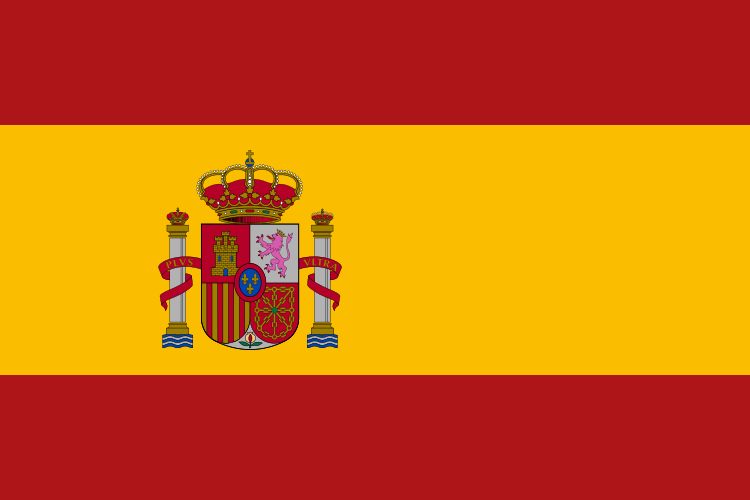
The flag of Spain, known as la Rojigualda ('the red and yellow'), consists of three horizontal stripes — a narrow red stripe on top, a wide yellow (gold) stripe in the center (double the height of each red stripe), and a narrow red stripe on the bottom. The national coat of arms appears on the hoist side of the gold stripe.
The red and yellow colors were chosen by King Charles III in 1785 specifically to make the flag easily visible at sea, as the previous white Bourbon flag was too easily confused with the flags of other Bourbon-ruled nations. The coat of arms includes the Pillars of Hercules (representing the Strait of Gibraltar), the royal crown, and the arms of the historical kingdoms that united to form Spain.
The current version was officially adopted on December 19, 1981.
What the colors & design mean
Red and gold are the traditional colors of the Spanish monarchy, chosen for high visibility at sea. The coat of arms represents the historical kingdoms of Castile, Leon, Aragon, Navarre, and Granada, and the Pillars of Hercules with the motto 'Plus Ultra' (Further Beyond) reference Spain's overseas empire.
Pattern: Horizontal Stripes
Bordering countries (4)
Fun Facts
- The red and yellow colors were specifically chosen by King Charles III in 1785 because they stood out at sea — the previous white Bourbon flag was indistinguishable from the French, Neapolitan, and other Bourbon monarchy flags on the ocean.
- The motto 'Plus Ultra' ('Further Beyond') on the Pillars of Hercules replaced the ancient warning 'Non Plus Ultra' ('Nothing Further Beyond'), reflecting Spain's discovery and colonization of the Americas.
- The Spanish Republican flag (1931-1939) added a purple stripe at the bottom, which remains a symbol of left-wing and republican movements in Spain today.
- Spain's coat of arms on the flag includes a pomegranate at the bottom, representing the Kingdom of Granada — the last Moorish stronghold conquered during the Reconquista in 1492.
Similar looking flags
These flags share similar colors and patterns:
More Europe Flags
🇦🇱 Albania · 🇦🇩 Andorra · 🇦🇹 Austria · 🇧🇾 Belarus · 🇧🇪 Belgium · 🇧🇦 Bosnia and Herzegovina · 🇧🇬 Bulgaria · 🇭🇷 Croatia
Explore by Category
Test Your Knowledge!
Think you can identify the flag of Spain?
Play Flag Quiz