Flag of Germany
Europe
Quick Facts
- Capital
- Berlin
- Flag adopted
- 1949
- Population
- 83,491,249
- Area
- 357,114 km²
- Languages
- German
- Currency
- euro (€) — EUR
- Demonym
- German
- Government
- federal parliamentary republic
- Subregion
- Western Europe
- Driving side
- Right
- Timezones
- UTC+01:00
- Independence
- 1871
Religions
- None 43.8%
- Roman Catholic 24.8%
- Protestant 22.6%
- Other 5.1%
- Muslim 3.7%
About This Flag
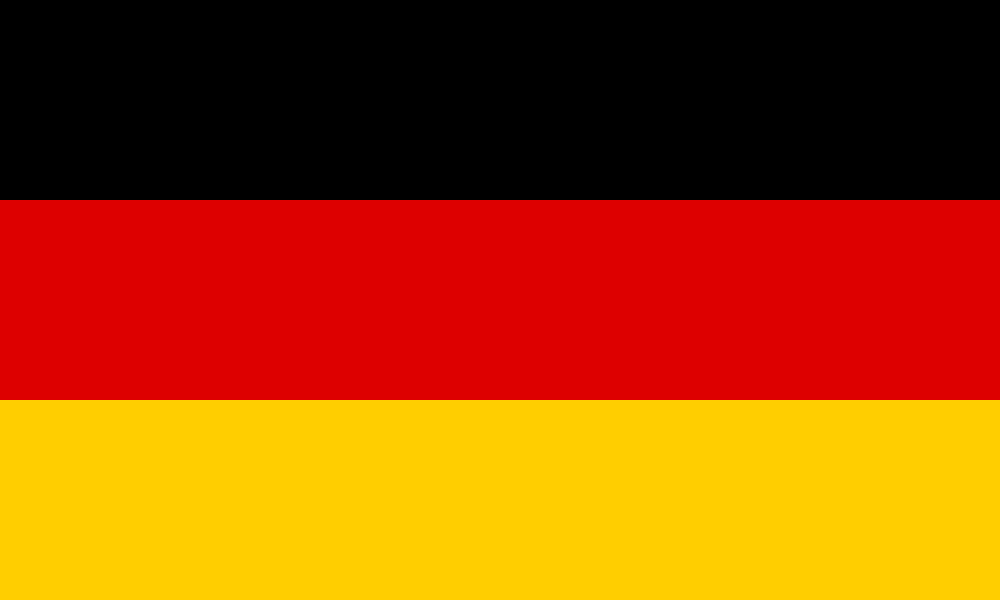
The German flag consists of three equal horizontal bands of black on top, red in the center, and gold (officially yellow) on the bottom. The colors originated from the uniforms of the Lutzow Free Corps, a volunteer unit that fought against Napoleon in the early 19th century — their uniforms were black with red facings and gold buttons.
The black-red-gold tricolor was first adopted as a symbol of German unity and liberal democracy by the student Burschenschaften movement in 1815 and was used during the 1848 revolution. It was adopted as the flag of the Weimar Republic in 1919, replaced by the Nazi regime in 1933, and restored by both West Germany and East Germany (with emblem) after World War II.
The current flag was officially adopted on May 23, 1949.
What the colors & design mean
Black represents determination and the dark history overcome. Red symbolizes bravery, courage, and the blood shed for German unity. Gold represents generosity, prosperity, and the liberal democratic ideals that the colors have symbolized since the 1848 revolution.
Pattern: Horizontal Stripes
Bordering countries (9)
Fun Facts
- The black-red-gold colors trace back to the Lutzow Free Corps volunteers who fought Napoleon — their black coats, red trim, and gold buttons became symbols of pan-German nationalism and liberal democracy.
- Germany has alternated between black-red-gold (associated with democracy) and black-white-red (associated with the Prussian-dominated German Empire) multiple times, with each color scheme representing a different political ideology.
- East Germany used the same black-red-gold tricolor but added a communist emblem (hammer, compass, and wheat wreath) to the center — after reunification in 1990, the plain tricolor was kept.
- The 1848 Frankfurt Parliament adopted black-red-gold as the flag of a unified democratic Germany, but the revolution failed — it took another century before the colors were permanently established.
Similar looking flags
These flags share similar colors and patterns:
More Europe Flags
🇦🇱 Albania · 🇦🇩 Andorra · 🇦🇹 Austria · 🇧🇾 Belarus · 🇧🇪 Belgium · 🇧🇦 Bosnia and Herzegovina · 🇧🇬 Bulgaria · 🇭🇷 Croatia
Explore by Category
Test Your Knowledge!
Think you can identify the flag of Germany?
Play Flag Quiz