Flag of Mongolia
Asia
Quick Facts
- Capital
- Ulan Bator
- Flag adopted
- 2011
- Population
- 3,544,835
- Area
- 1,564,110 km²
- Languages
- Mongolian
- Currency
- Mongolian tögrög (₮) — MNT
- Demonym
- Mongolian
- Government
- semi-presidential republic
- Subregion
- Eastern Asia
- Driving side
- Right
- Timezones
- UTC+07:00, UTC+08:00
- Independence
- 1911
Religions
- Buddhist 51.8%
- None 40.6%
- Muslim 3.2%
- Shaman 2.5%
- Christian 1.3%
- Other 0.6%
About This Flag
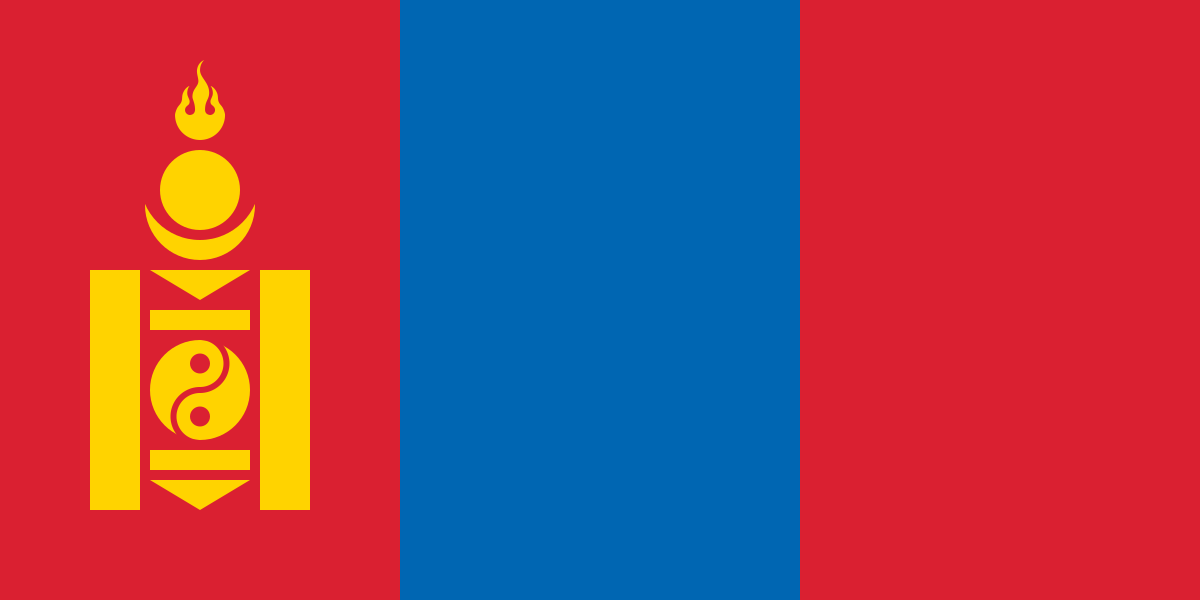
The flag of Mongolia consists of three equal vertical bands of red on the hoist and fly sides with a blue band in the center. On the red band nearest the hoist sits the Soyombo, a yellow national symbol composed of a columnar arrangement of geometric shapes including fire, sun, moon, triangles, rectangles, and the yin-yang.
The blue represents the eternal blue sky, a sacred concept in Mongolian Tengriism. The red stripes symbolize progress and prosperity.
The Soyombo, created in 1686 by the Buddhist monk and scholar Zanabazar, is an ancient national emblem whose elements carry layered meanings about cosmology, balance, and national independence. The flag was last modified on July 8, 2011, when a slightly lighter blue shade was standardized.
What the colors & design mean
Blue represents the eternal blue sky (Mongke Tengri), sacred in Mongolian tradition. Red symbolizes progress and prosperity. The Soyombo's flame represents growth and renewal, the sun and moon symbolize eternal existence, the triangles mean defeat of enemies, the rectangles stand for honesty and justice, and the yin-yang represents complementary forces.
Pattern: Vertical Stripes
Bordering countries (2)
Fun Facts
- The Soyombo symbol was created in 1686 by Zanabazar, Mongolia's first Buddhist spiritual leader, who also invented the Soyombo script — an alphabet that was used for writing Mongolian and Sanskrit.
- Mongolia is the most sparsely populated sovereign nation in the world, with about 3.4 million people in a territory roughly the size of Western Europe.
- The original communist-era version of the flag (1940-1992) included a five-pointed star above the Soyombo; the star was removed after Mongolia's democratic transition.
- The concept of 'Eternal Blue Sky' (Mongke Tengri) was central to the Mongol Empire under Genghis Khan, who invoked it as a source of divine authority.
Similar looking flags
These flags share similar colors and patterns:
More Asia Flags
🇦🇫 Afghanistan · 🇦🇲 Armenia · 🇦🇿 Azerbaijan · 🇧🇭 Bahrain · 🇧🇩 Bangladesh · 🇧🇹 Bhutan · 🇧🇳 Brunei · 🇰🇭 Cambodia
Explore by Category
Test Your Knowledge!
Think you can identify the flag of Mongolia?
Play Flag Quiz