Flag of Uruguay
South America
Quick Facts
- Capital
- Montevideo
- Flag adopted
- 1830
- Population
- 3,499,451
- Area
- 181,034 km²
- Languages
- Spanish
- Currency
- Uruguayan peso ($) — UYU
- Demonym
- Uruguayan
- Government
- presidential republic
- Subregion
- South America
- Driving side
- Right
- Timezones
- UTC-03:00
- Independence
- 1825
Religions
- None 47.3%
- Roman Catholic 36.5%
- Protestant 5%
- Unspecified 3.4%
- African American Cults/Umbanda 2.8%
- Believer 1.8%
- Atheist 1.3%
- Other 1%
- Jehovah's Witness 0.6%
- Agnostic 0.3%
- Latter-day Saint 0.2%
About This Flag
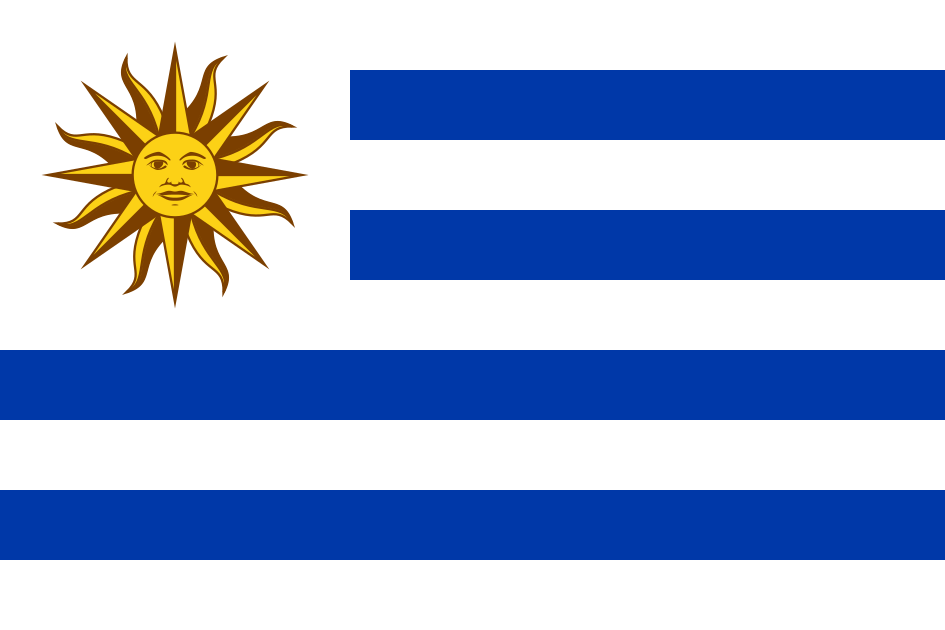
The flag of Uruguay, known as the Pabellon Nacional, consists of nine alternating white and blue horizontal stripes with a white canton in the upper-hoist corner bearing a golden Sun of May with a human face. The nine stripes represent the nine original departments (provinces) of Uruguay at independence.
The Sun of May is the same symbol that appears on Argentina's flag, representing the Inca sun god Inti and commemorating the May Revolution of 1810 in Buenos Aires, which launched the independence movement across the Rio de la Plata region. The blue and white colors symbolize the principles of liberty and peace.
The flag was adopted on July 11, 1830, and its design was influenced by the flag of the United States.
What the colors & design mean
The nine stripes represent Uruguay's nine original departments. Blue symbolizes the sky and liberty. White stands for peace and purity. The Sun of May represents the Inca sun god Inti and commemorates the beginning of the independence movement in the Rio de la Plata region.
Pattern: Horizontal Stripes, Canton Design
Bordering countries (2)
Fun Facts
- Uruguay's flag was modeled after the American Stars and Stripes — the alternating horizontal stripes were directly inspired by the U.S. flag's design.
- The Sun of May appears on both Argentina's and Uruguay's flags, reflecting their shared revolutionary heritage as former territories of the Viceroyalty of the Rio de la Plata.
- Uruguay hosted and won the first FIFA World Cup in 1930, and its small population of about 3.5 million makes it one of the smallest countries to have won the tournament.
- Uruguay was one of the first countries in the world to establish an eight-hour work day, free public education, and the separation of church and state in the early 20th century.
Similar looking flags
These flags share similar colors and patterns:
More South America Flags
🇦🇷 Argentina · 🇧🇴 Bolivia · 🇧🇷 Brazil · 🇨🇱 Chile · 🇨🇴 Colombia · 🇪🇨 Ecuador · 🇬🇾 Guyana · 🇵🇾 Paraguay
Explore by Category
Test Your Knowledge!
Think you can identify the flag of Uruguay?
Play Flag Quiz