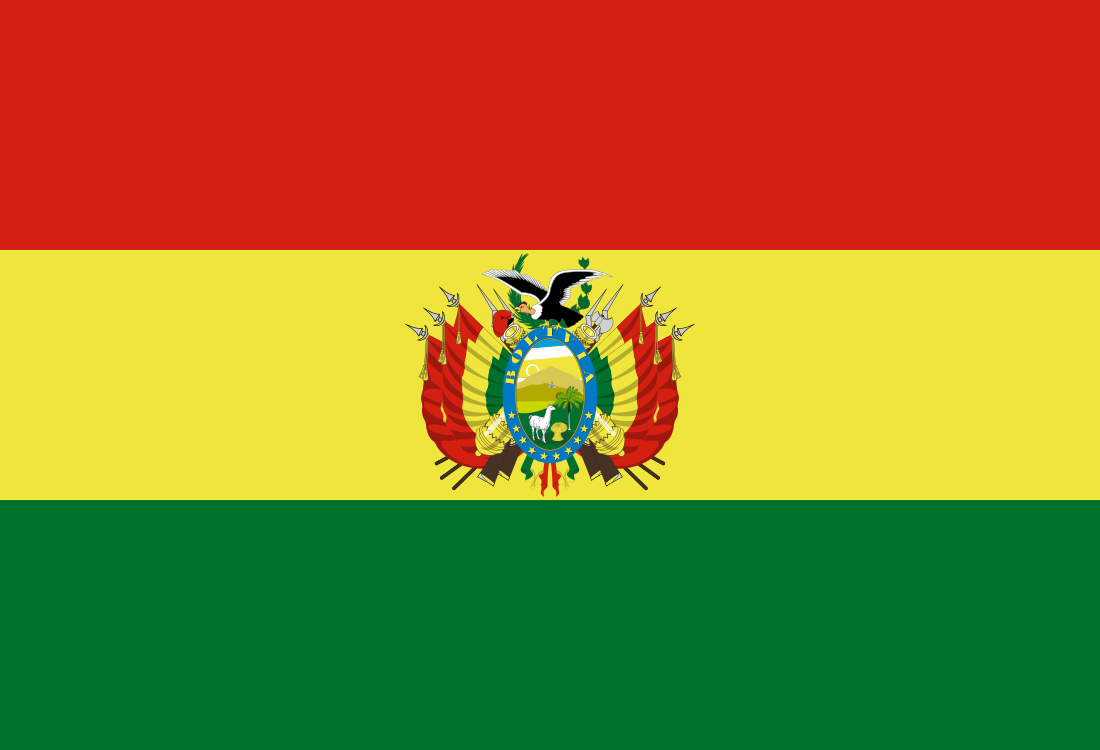
Flag of Bolivia
South America
Quick Facts
- Capital
- Sucre
- Flag adopted
- 1851
- Population
- 11,365,333
- Area
- 1,098,581 km²
- Languages
- Aymara, Guaraní, Quechua, Spanish
- Currency
- Bolivian boliviano (Bs.) — BOB
- Demonym
- Bolivian
- Government
- presidential republic
- Subregion
- South America
- Driving side
- Right
- Timezones
- UTC-04:00
- Independence
- 1825
Religions
- Roman Catholic 65%
- Protestant 19.6%
- None 6.1%
- Other 4.8%
- Atheist 1.7%
- Unspecified 1.3%
- Believer 0.9%
- Agnostic 0.6%
About This Flag
The flag of Bolivia consists of three equal horizontal bands of red on top, yellow in the center, and green on the bottom, with the national coat of arms centered on the yellow stripe (on the state flag variant). The red represents the blood of national heroes shed for the birth and preservation of the republic.
The yellow symbolizes the country's mineral wealth and resources. The green stands for the fertility of the land, the lush natural environment, and hope.
Bolivia also recognizes the Wiphala — a square banner of 49 multicolored squares arranged in a diagonal rainbow pattern — as a dual national flag representing the indigenous peoples, particularly the Aymara and Quechua. The current tricolor was adopted on October 31, 1851.
What the colors & design mean
Red represents the blood shed by national heroes for independence and sovereignty. Yellow symbolizes the country's rich mineral resources, including its historical silver and tin wealth. Green stands for the fertility of the land, the Amazon region, and hope for the future.
Pattern: Horizontal Stripes
Bordering countries (5)
Fun Facts
- Bolivia is one of the few countries in the world with two official flags — the traditional tricolor and the Wiphala, a square rainbow patchwork flag representing indigenous Andean peoples, given co-equal status in the 2009 constitution.
- Bolivia has two capital cities: Sucre (the constitutional capital and seat of the judiciary) and La Paz (the seat of the executive and legislative branches), which at 3,640 meters is the highest administrative capital in the world.
- The country is named after Simon Bolivar, the Venezuelan-born revolutionary who led the liberation of much of South America from Spanish rule.
- Bolivia's Salar de Uyuni is the world's largest salt flat, covering over 10,000 square kilometers, and contains the world's largest known lithium reserves.
Similar looking flags
These flags share similar colors and patterns:
More South America Flags
🇦🇷 Argentina · 🇧🇷 Brazil · 🇨🇱 Chile · 🇨🇴 Colombia · 🇪🇨 Ecuador · 🇬🇾 Guyana · 🇵🇾 Paraguay · 🇵🇪 Peru
Explore by Category
Test Your Knowledge!
Think you can identify the flag of Bolivia?
Play Flag Quiz