Flag of South Korea
Asia
Quick Facts
- Capital
- Seoul
- Flag adopted
- 1949
- Population
- 51,159,889
- Area
- 100,210 km²
- Languages
- Korean
- Currency
- South Korean won (₩) — KRW
- Demonym
- South Korean
- Government
- presidential republic
- Subregion
- Eastern Asia
- Driving side
- Right
- Timezones
- UTC+09:00
- Independence
- 1945
Religions
- None 60%
- Protestant 17%
- Buddhist 16%
- Roman Catholic 6%
About This Flag
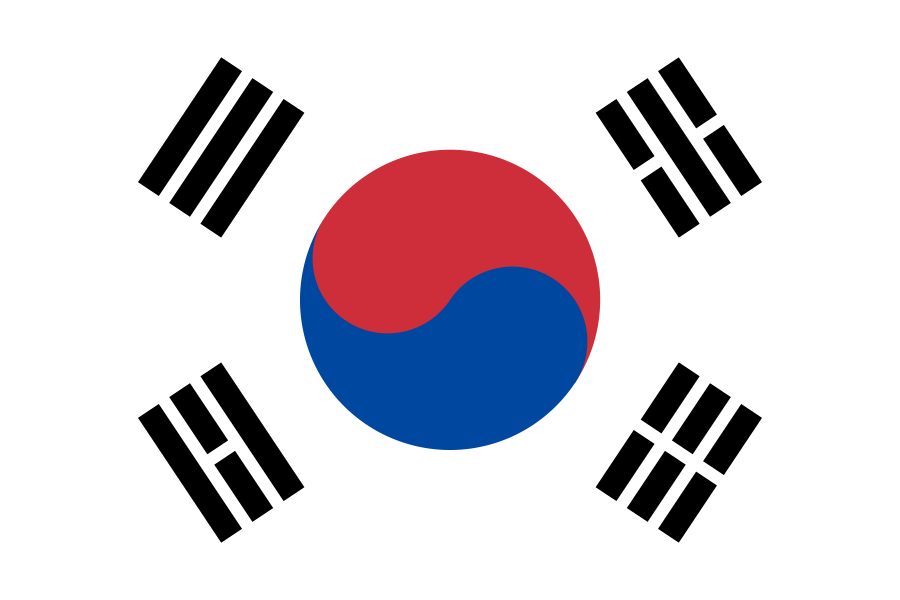
The flag of South Korea, called Taegukgi, features a white field with a red and blue Taeguk (yin-yang symbol) at its center, surrounded by four black trigrams (gwae) from the I Ching positioned in each corner. The white background represents peace, purity, and the Korean people's love of peace.
The Taeguk symbolizes the balance and harmony of opposing cosmic forces — the red upper half represents positive cosmic forces (yang) and the blue lower half represents negative cosmic forces (yin). The four trigrams represent heaven (geon), earth (gon), water (gam), and fire (ri), embodying the principles of movement and harmony.
The flag was first conceived in 1882 and formally adopted on October 15, 1949.
What the colors & design mean
White represents peace, purity, and the Korean people. The red-and-blue Taeguk symbolizes cosmic balance between opposing forces (yin and yang). The four trigrams represent the four classical elements and cardinal principles: heaven, earth, water, and fire.
Pattern: Solid Field
Bordering countries (1)
Fun Facts
- South Korea's flag is one of the only national flags based on philosophical and cosmological concepts from the I Ching (Book of Changes), an ancient Chinese classical text over 3,000 years old.
- The first version of the Taegukgi was designed in 1882 by diplomat Park Yeong-hyo during a mission to Japan — the exact design has been refined several times since.
- Only 4 of the 8 I Ching trigrams are used on the flag, and they are arranged in opposite pairs: heaven/earth and water/fire, representing fundamental dualities of nature.
- During Japanese colonial rule (1910-1945), the Taegukgi was banned, and possessing one was an act of resistance that could result in imprisonment.
More Asia Flags
🇦🇫 Afghanistan · 🇦🇲 Armenia · 🇦🇿 Azerbaijan · 🇧🇭 Bahrain · 🇧🇩 Bangladesh · 🇧🇹 Bhutan · 🇧🇳 Brunei · 🇰🇭 Cambodia
Explore by Category
Test Your Knowledge!
Think you can identify the flag of South Korea?
Play Flag Quiz